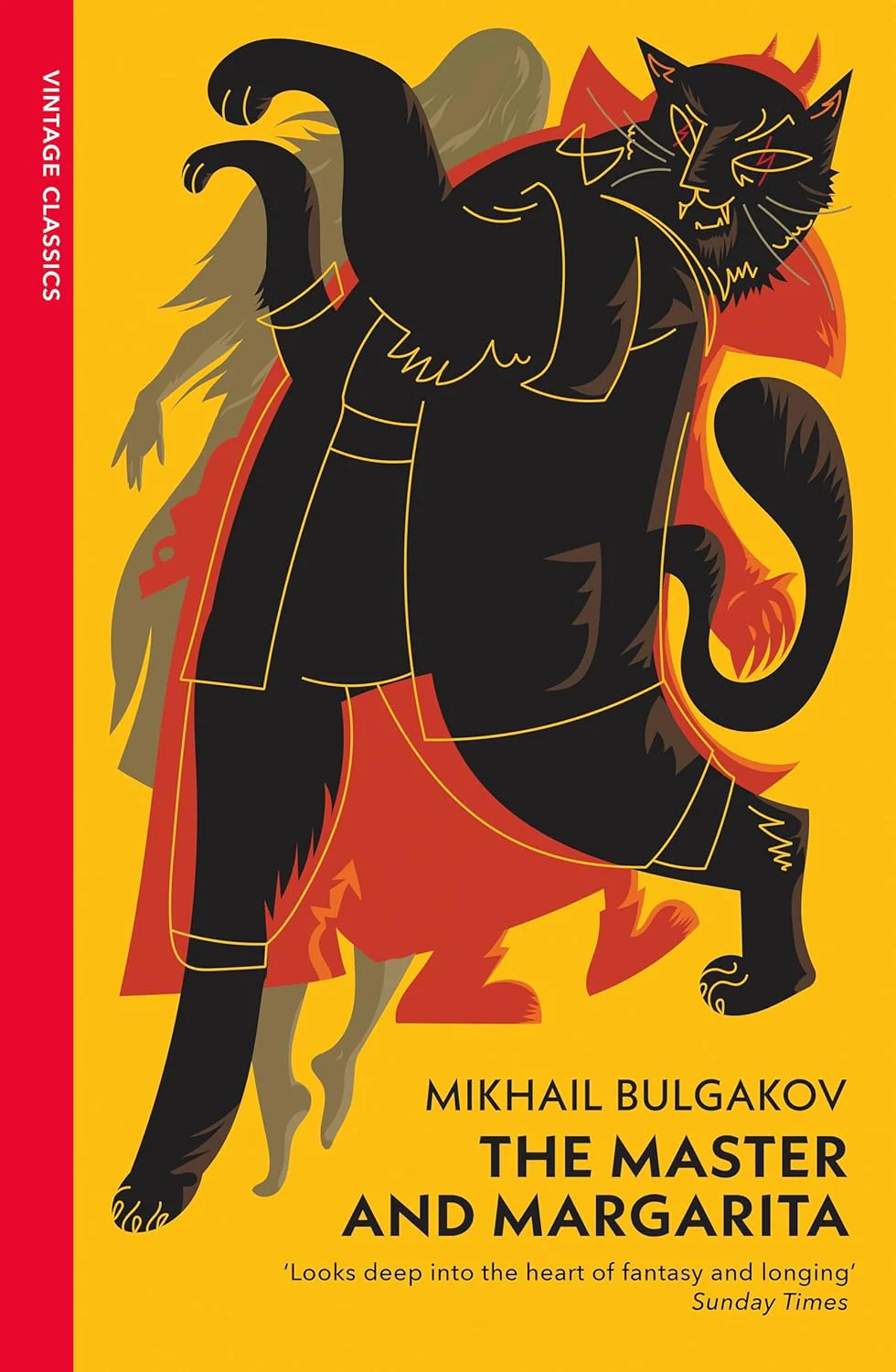
Picking up The Count of Monte Cristo in a bookshop, someone recommended this alongside it. Both books are about a figure who arrives from outside the normal order, Dantès also turns a corrupt system’s logic against itself. Dumas believes in justice as a recoverable state. Bulgakov isn’t sure?
A metaphysical study of power, truth, repression, and psychological freedom under systems that demand ideological conformity.
Woland functions more like a force of metaphysical revelation. He exposes vanity, greed, cowardice, performative morality, ideological conformity, and the fragility of supposedly rational systems. Consistently punishes people for what they actually are rather than what they claim to be.
“Literature can be a catalyst for change. But it can also be a safety valve for a release of tension and one that results in paralysis.”
The parallel storyline, set in Jerusalem, follows Pontius Pilate’s interrogation of Yeshua Ha-Notsri. Portrays cowardice as the real sin.
Mikhail Bulgakov was dying of hypertensive nephrosclerosis during completion, four weeks before his death. Forensic Analysis showed traces of morphine on the original manuscript. Stalin reportedly admired Bulgakov’s work personally, particularly The Days of the Turbins. Stalin allegedly saw the play many times and intervened at points to protect Bulgakov from total destruction. There are even accounts of Stalin personally calling him after Bulgakov wrote to the Soviet government asking either to be allowed to work or to leave the USSR.
Bulgakov was not fully eliminated like many Soviet writers, but he also was not free. He existed in this suspended state where he could not publish, emigrate, nor openly criticise the regime.
Bulgakov was writing under conditions where reality itself could not be described directly anymore. So the truth had to return disguised as fantasy, satire, theology, absurdity, and the supernatural.
Key Ideas
Cowardice as the real sin
“manuscripts don’t burn” authentic work outlasts the institutions that suppress it
Reality itself as unstable under authoritarian social systems. In Bulgakov’s Moscow, everyone is performing belief, institutions become absurd theatre.
Bureaucracy replaces truth. People self-censor so deeply that unreality becomes normalized.