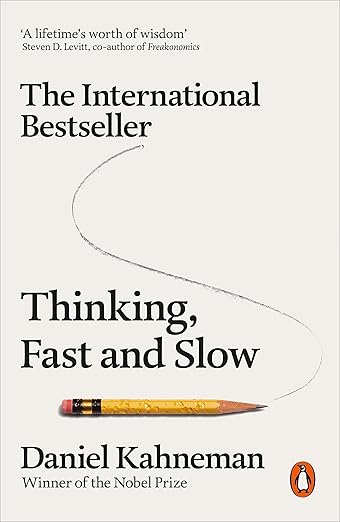
Synthesises decades of research in behavioral science, to explain why human beings are predictably irrational and often make error-prone decisions.
“Nothing in life is as important as you think it is, while you are thinking about it”
Key Principle: The Mind has two systems. System 1 (fast, intuitive) and System 2 (slow, analytical)
Part 1: Two Systems
System 1 operates automatically and quickly, with no effort and no voluntary control.
System 2 allocates attention to effortful mental activities. It’s associated with the subjective experience of agency, choice, and concentration.
All operations of System 2 require attention and are disrupted when attention is drawn away.
System 2 has some ability to change the way System 1 works, by programming the normally automatic functions of attention and memory.
System 1 generates impressions, intuitions, intentions, and feelings. Those endorsed by System 2 turn into beliefs and voluntary actions.
Most of what System 2 thinks and does originates in your System 1, but System 2 takes over when things get difficult, and it normally has the last word.
One of the tasks of System 2 is to overcome the impulses of System 1. System 2 is in charge of self-control.
System 2 is too slow and inefficient to substitute for System 1. The best we can do is to recognize when mistakes are likely, and to try harder to avoid significant mistakes when the stakes are high.
| System 1 | System 2 | |
|---|---|---|
| Speed | Instant, milliseconds | Slow, seconds to minutes |
| Effort | Effortless | Requires concentration |
| Awareness | Unconscious | Conscious |
| Logic | Associative, pattern-based | Sequential, rule-based |
| Share of decisions | ~96% | ~4% |
| Example | Reading a facial expression | Calculating 17 × 24 |
| Error type | Predictable biases | Laziness, cognitive overload |
| Default mode | Always on | Activated only when needed |
Source: Behavioural Design Academy
Key Principle: Effort is a limited resource, the brain budgets attention via System 1 and System 2.
Part 2: Attention and Effort
The brain acts as an economist, “budgeting” its attention to minimize exertion, a tendency known as the Law of Least Effort.
The pupils in our eyes are sensitive indicators of mental effort; The more System 2 exerts mental effort, the more they dilate.
A crucial capability of System 2 is that it can program memory to obey an instruction that overrides habitual responses.
Effortful thinking and self-control are part of the same limited resource pool. Using self-control for one task reduces the capacity for it later, a state known as ego depletion
Other Key Concepts:
Narrative Fallacy → Flawed stories of the past shape our views of the world… and our expectations for the future.
Outcome Bias → We are prone to blame decision makers for good decisions that worked out badly… and to give too little credit for successful moves that appear obvious only after the fact
Theory-Induced Blindness → Once you have accepted a theory and used it as a tool in your thinking… it is extraordinarily difficult to notice it’s flaws.
Focusing Illusion → Nothing in life is as important as you think it is when you are thinking about it
Availability Heuristic → We judge the frequency of an event… by the ease with which instances come to mind.
“If you care about being thought credible and intelligent, do not use complex language where simpler language will do.”
“The confidence that individuals have in their beliefs depends mostly on the quality of the story they can tell about what they see, even if they see little.”
“I have always believed that scientific research is another domain where a form of optimism is essential to success: I have yet to meet a successful scientist who lacks the ability to exaggerate the importance of what he or she is doing, and I believe that someone who lacks a delusional sense of significance will wilt in the face of repeated experiences of multiple small failures and rare successes, the fate of most researchers.”
Breakdown
https://github.com/mgp/book-notes/blob/master/thinking-fast-and-slow.markdown