
I spent a couple of weeks building a model to predict which oncology drugs would advance from Phase 2 to Phase 3. It didn’t work. Walk-forward AUC sat between 0.50 and 0.55 across every feature combination I tried: pathway position, publication sentiment, genetic evidence, novel-MOA flags, sponsor identity. None of them generalised out of sample.
But there was a chart I liked too much to let die at the same time.
The chart segments oncology Phase 2 completion rates by both target and indication: PD-1 in NSCLC, PD-1 in melanoma, EGFR in colorectal, and so on. Some cells complete near 100%, some near 25%. Same drug class, very different outcome. The implicit reading is that indication biology does matter. Some cancers are harder for some drug classes than others, and the chart shows the pattern.
The biggest visible deltas often compare a cell with thirty-four trials against one with three. A defensible minimum is something like ten distinct drugs in the cell and twenty Phase 2 trials, pre-specified. Of 663 cells, fifteen survive that filter. Two-point-three percent.
That’s a much smaller story, but it’s still a story. The tighter metric is whether a Phase 2 program produces a Phase 3 trial at all. Within those fifteen filtered cells: PD-1 in NSCLC at 30%, PD-1 in ‘other’ at 8%; PD-L1 in NSCLC at 52%, PD-L1 in ‘other’ at 19%; EGFR in NSCLC at 42%, EGFR in ‘other’ at 0%. So far, so biology.
I added sponsor type to the analysis. The database tags every trial as INDUSTRY, NIH, OTHER (mostly academic and hospital), and a few smaller categories. Aggregated across the whole sample, the INDUSTRY P3-to-P2 ratio is 0.63. The non-industry ratio is 0.08. Eight to one. Bootstrap 95% confidence interval [6.4, 10.2]. That gap is so large that any cross-cell comparison is mostly a comparison of which sponsor mix happens to be in each cell.
The cleaner test is to fit a logistic regression with sponsor and cell as predictors. Once sponsor type was included in the model, most of the apparent indication-level structure collapsed. Sponsor capability was driving the pattern. Same target, same indication: in nine of nine cells with both strata represented, industry P3-ratio exceeded non-industry P3-ratio.
Why is the sponsor effect so massive? Three mechanisms, Industry-sponsored Phase 2 trials are larger, more rigorously designed, and more often run with a Phase 3 plan already drafted; the outcome variable (does a Phase 3 trial exist) partly captures intent to advance, not just data signal. Drugs cross sponsor categories: a compound owned by industry in Phase 2 may be licensed or co-developed before Phase 3, so the same molecule appears in different sponsor strata at different stages. And industry concentrates in commercially attractive indications such as NSCLC, breast, and prostate, while less commercial cancers skew academic. The sponsor effect at the indication level is partly a measure of which indications industry chooses to chase in the first place.
None of those mechanisms is the biology story I wanted the chart to tell.
The defensible version of this finding reads narrower:
Within target-classified oncology programs, sponsor type is the strongest predictor of whether a Phase 2 trial advances to Phase 3 within the observation window. After sponsor adjustment, target×indication contributes little additional information at the resolution this dataset supports.
That is a much smaller claim than “we discovered indication-level biology.” It is also the one the data actually carry.
NSCLC tends to be the higher bar in most pairs, but the magnitude loses an order of magnitude when sponsor is held constant. The “biology” explanation requires the magnitudes to be real. They aren’t, at this resolution.
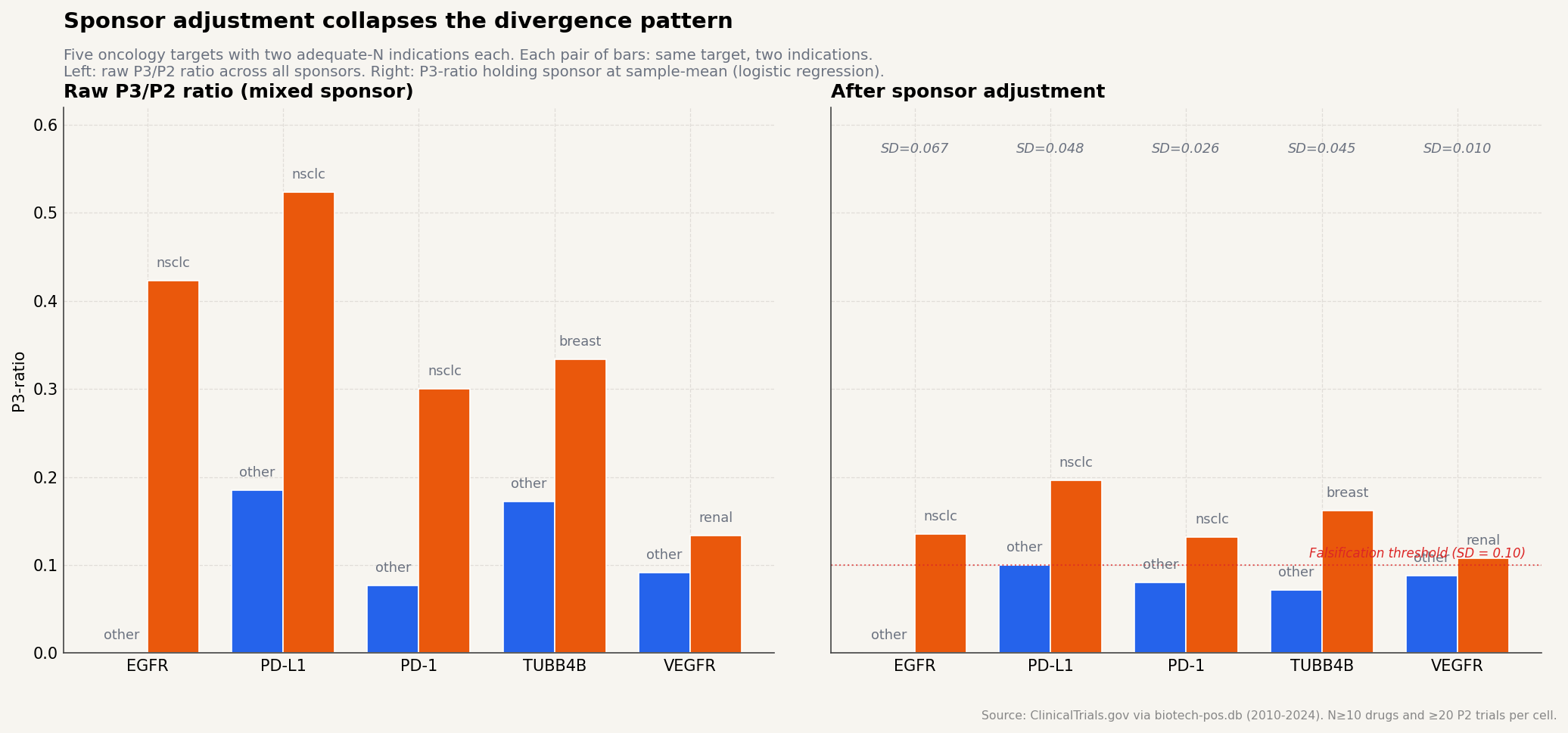
At the resolution this dataset supports, indication-level effects are much smaller than they initially appeared once sponsor effects are controlled.
I’m leaving the original divergence chart in the project for context, but any public version will only show adequately powered cells and will stratify rates by sponsor type. The mixed-sponsor version implies more granularity than the data support.
If there is still a useful version of the original question, it is probably narrower and more drug-level than cell-level:
Within industry-sponsored oncology Phase 2 programs, do drugs with unusually strong preclinical or Phase 1 efficacy signals advance more often than baseline?
That is a different question on a richer sample (731 industry Phase 2 trials instead of fifteen surviving cells) and it is probably the better one.